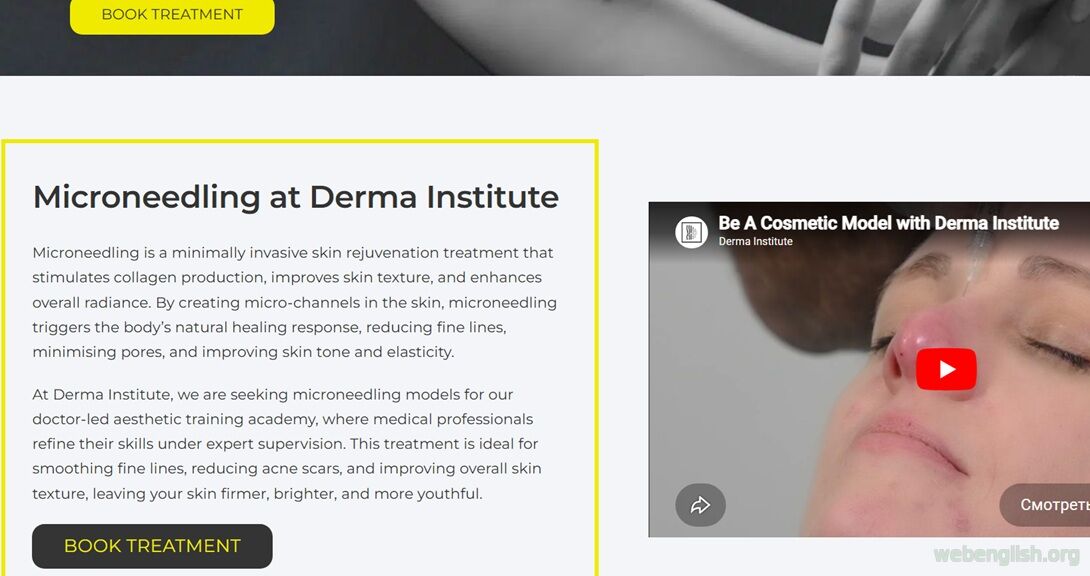
A beauty and aesthetics training academy is looking for volunteer models for a skin rejuvenation and microneedling workshop. The procedure will be performed by trainees under professional supervision. Models will not be paid, but they will receive the procedure free of charge or at a reduced model fee.
You would like to apply as a model, but you are not sure whether you meet all the requirements.
You plan to contact the course coordinator to clarify several points before applying.
Write an email to the course coordinator. In your email, do the following:
Express your interest in becoming a model for the microneedling workshop.
Explain that you have sensitive, acne-prone skin and ask whether this could make you unsuitable for the procedure.
Mention that you may have a mild allergy to some cosmetic products and ask whether a patch test or medical questionnaire is required.
Ask whether the procedure is performed under professional supervision and what the expected recovery time is.
Ask whether it would be possible to attend at a slightly different time if the advertised appointment does not suit you.
Write as much as you can in complete sentences.
Your email should be polite and clear.
I am writing to inquire about [briefly state the purpose of the email]. I recently learned about [the organization / service / course], and I am very interested in the opportunities it offers.
In particular, I would like to request further information regarding [fees / conditions / availability / procedures]. I would also appreciate it if you could clarify whether [specific request or condition] is possible.
Additionally, I would like to inform you that [relevant personal detail or specification], and I was wondering whether your organization works with or accommodates [this type / model / situation].
I would be grateful if you could let me know [what action or confirmation you are expecting] at your convenience. Thank you in advance for your time and assistance.
to apply as a model — подать заявку в качестве модели
to take part in a workshop — принять участие в практическом занятии / мастер-классе
a skin rejuvenation procedure — процедура омоложения кожи
a microneedling session — сеанс микронидлинга
sensitive skin — чувствительная кожа
acne-prone skin — кожа, склонная к акне
to be suitable for the procedure — подходить для процедуры
to make someone unsuitable for the treatment — сделать кого-либо неподходящим кандидатом для процедуры
a mild allergy to cosmetic products — лёгкая аллергия на косметические средства
to have an allergic reaction to something — иметь аллергическую реакцию на что-либо
a patch test — кожная проба / тест на аллергию
a medical questionnaire — медицинская анкета
professional supervision — профессиональное наблюдение / контроль специалиста
expected recovery time — ожидаемое время восстановления
possible side effects — возможные побочные эффекты
aftercare instructions — рекомендации по уходу после процедуры
available appointment slots — доступные временные слоты для записи
to attend at a slightly different time — прийти в немного другое время
Useful grammar patterns
1. in case + Present Simple — на случай, если...
I would like to know what I should do in case my skin reacts badly after the procedure.
Я хотела бы узнать, что мне следует делать, если моя кожа плохо отреагирует после процедуры.
Could you please let me know in case I need to complete a medical questionnaire before the appointment?
Не могли бы вы сообщить мне, если мне нужно будет заполнить медицинскую анкету до приёма?
2. what if + Present Simple — что, если...
What if I have sensitive skin? Would I still be allowed to take part in the workshop?
Что, если у меня чувствительная кожа? Мне всё равно разрешат принять участие в мастер-классе?
What if I have an allergic reaction to some cosmetic products? Should I take a patch test first?
Что, если у меня аллергическая реакция на некоторые косметические средства? Нужно ли мне сначала пройти кожную пробу?
3. I wonder + indirect question — мне интересно / я хотела бы узнать...
I wonder whether my skin type would be suitable for this procedure.
Я хотела бы узнать, подойдёт ли мой тип кожи для этой процедуры.
I wonder if it would be possible to attend at a slightly different time.
Я хотела бы узнать, можно ли прийти в немного другое время.
I wonder how long the recovery period usually lasts after microneedling.
Я хотела бы узнать, сколько обычно длится восстановительный период после микронидлинга.
4. It is advisable that someone should do something — рекомендуется, чтобы кто-либо сделал что-либо
Is it advisable that I should take a patch test before the treatment?
Рекомендуется ли мне пройти кожную пробу перед процедурой?
Would it be advisable that I should avoid using active skincare products before the appointment?
Было бы желательно, чтобы я не использовала активные косметические средства перед приёмом?
5. to be likely / unlikely to do something — вероятно / маловероятно, что кто-либо что-либо сделает
Is sensitive skin likely to react badly to microneedling?
Вероятно ли, что чувствительная кожа плохо отреагирует на микронидлинг?
Am I unlikely to be accepted as a model if I have acne-prone skin?
Маловероятно ли, что меня примут в качестве модели, если у меня кожа, склонная к акне?
6. to have difficulty / trouble doing something — испытывать трудности с чем-либо
I may have difficulty attending the appointment at the advertised time.
Возможно, мне будет трудно прийти в указанное время.
Would it be a problem if I had trouble completing the medical form before the session?
Будет ли проблемой, если у меня возникнут трудности с заполнением медицинской формы до сеанса?
Pregnancy Robots: A New Path for Assisted Reproduction?
In recent years, research groups in China and a handful of labs abroad have publicized prototypes of so-called pregnancy robots—ex-utero systems that aim to carry a human pregnancy outside the body under strict medical oversight. Advocates claim these platforms could reduce maternal risk, expand options for families facing infertility, and lower neonatal complications. Their method combines three tightly integrated components:
1) Ex-utero gestational chamber.
A sealed bioreactor—sometimes called an artificial womb—circulates sterile amniotic fluid around the embryo/fetus while micro-actuators reproduce gentle uterine movements. Gas exchange and temperature are stabilized by membranes that mimic physiological conditions from implantation through late gestation.
2) Synthetic placenta with hormonal control.
Instead of connecting to a pregnant person’s blood, a microfluidic “robotic placenta” delivers oxygen and nutrients and removes waste through ultra-thin exchange membranes. A separate module administers tiny, precisely timed doses of pregnancy hormones (progesterone, estrogens, placental lactogen, etc.) to reproduce the endocrine environment believed to guide normal development.
3) AI obstetrician (closed-loop monitoring).
High-resolution ultrasound arrays, optical sensors, and fetal ECG feed a machine-learning controller that continually adjusts fluid flow, pressure, and hormone schedules for personalized gestation. Clinicians can supervise remotely; alarms trigger human intervention if any parameter leaves its safe range. Proponents argue that, together, these features will make ex-utero gestation safe, scalable, and ethically manageable under hospital regulations.
If validated in trials, pregnancy robots could supplement neonatal intensive care, minimize preterm complications, and offer a new path to parenthood while relieving pressure on overburdened maternity units. Supporters conclude that the combination of bioreactor stability, synthetic placental exchange, and AI control brings truly viable ex-utero pregnancy within reach.
Step 2. Listen to part of a lecture below and take notes.
Lecture (Biodevices Seminar): Why the Promises of “Pregnancy Robots” Are Premature
Professor: The robot-based reproduction technology sketches an appealing blueprint, but each of its three pillars faces obstacles that are far from solved.
First, the ex-utero gestational chamber. A uterus is not just warm fluid and gentle motion. Early pregnancy depends on implantation into maternal tissue, immune tolerance from the decidua, and extremely dynamic signaling between embryo and parent. We cannot recreate that tissue remodeling or the spiral-artery transformation that protects the placenta from pressure surges. Even later in gestation, maintaining correct shear stress, microbiome exposure, and mechanical cues matters for lung and gut maturation. Current chambers control temperature and flow, yes—but they lack the living interface that makes those cues adaptive. Without it, small instabilities can snowball into growth restriction or organ malformation.
Second, the synthetic placenta and hormone module. Gas and nutrient exchange in a real placenta occurs across billions of microvilli, with anti-clotting surfaces and exquisitely tuned gradients. Microfluidic membranes foul, micro-clots form, and oxygen carriers behave unpredictably under sustained flow. More importantly, endocrine control is not a simple “set the level” problem. Placental hormones follow pulsatile, circadian, and feedback-driven patterns that shift week by week and differ across pregnancies. A bottled cocktail cannot substitute for that complexity, and we lack robust biomarkers to tell us in real time whether our “hormone mimicry” is helping or quietly disrupting imprinting and other epigenetic programs.
Third, the AI obstetrician. Closed-loop control only works if the sensors are comprehensive and the training data cover edge cases. We do not have high-frequency, artifact-free measurements of fetal perfusion, neurodevelopment, or placental microcirculation over months. Ultrasound and optical signals are noisy; many relevant variables are unobservable. A model trained on limited animal data will face a distribution shift with human fetuses—exactly where prediction errors are least tolerable. Add unresolved issues of verification, cybersecurity, and liability, and it’s hard to see regulators approving a system that might make autonomous adjustments on the basis of uncertain inferences.
So while the inventors highlight stability, exchange, and control, the reality is missing maternal tissue biology, lacks a true placental analog, and depends on AI that cannot yet be proven safe across all scenarios. Until those foundations change, “pregnancy robots” remain an intriguing research direction—but not a feasible or ethical replacement for human gestation or established neonatal care.
Important!: Write out the three main ideas and their elaborations/illustrations/details that the lecturer provides. You should connect the points made in the lecture to the points made in the reading! When you hear the question, click to show the passage and question and begin your response.
Summarize the three components of the “pregnancy robot” described in the reading (ex-utero gestational chamber, synthetic placenta with hormonal control, and AI obstetrician). Then explain how the professor casts doubt on the feasibility of each component. Be sure to link each lecture point to the corresponding claim from the reading and use concrete details from the lecture.
Summarize the points made in the lecture, being sure to explain how they cast doubt on the points made in the reading.
[Overview] The text under analysis claims that pregnancy robots can succeed via a gestational chamber, a synthetic placenta with hormonal control, and an AI obstetrician.
The lecture challenges those claims, arguing that missing maternal tissue biology, lack of a true placental analog, and unsafe/insufficient AI control make the proposal premature.
[Body] Firstly, the reading argues a stable ex-utero chamber can mimic the womb, whereas the professor says implantation/decidual biology and spiral-artery remodeling can’t be replicated, risking maldevelopment.
Secondly, the reading’s synthetic placenta and hormone module are questioned: membranes foul, micro-clots form, and endocrine rhythms are complex; the lecturer warns about disrupted imprinting.
Finally, the AI controller is criticized: sensors are incomplete, key variables are unobservable, and distribution shift undermines safety; verification, cybersecurity, and liability remain unresolved.
[Conclusion] Therefore, the lecture systematically casts doubt on each of the reading’s three pillars with technical and ethical counterpoints.
Dear students, this week’s prompt is intentionally provocative: Would human cloning “destroy” the institution of the family, or reinvent it? Assume cloning is safe, legal, and regulated. Think concretely about legal parentage, identity and expectations for the child, and inequality/access. I’m looking for clear positions grounded in reasons and examples.
.
Student 1: Mina
I don’t think cloning would destroy families; it would expand them. Families already come in many forms—adoption, IVF, blended households—yet the core is care and commitment, not DNA ratios. With strict consent and psychological support, cloning could help infertile people become parents and keep children out of long fertility queues. The “identity pressure” concern is real, but that’s a parenting issue, not a technology issue. We already manage expectations with gifted kids or donor-conceived children through counseling and disclosure norms. Likewise, the law can define parentage clearly (e.g., nuclear donor + gestational parent as legal parents) just as it did for IVF. In short, responsible policy would let cloning reinvent family ties without undermining them.
Student 2: David
I’m convinced cloning would erode the family by turning kids into “legacy projects.” A cloned child might face relentless comparisons to the donor—same face, same expectations—which could distort identity formation. Legal parentage would also be messy: if the nuclear donor, gestational parent, and a partner all claim parental status, custody disputes could multiply. Finally, cloning would likely be expensive at first, widening inequality—wealthy families could select fashionable traits while others cannot, pushing social stigma onto the child and normalizing instrumental reasons for having kids. Adoption and existing reproductive tech already provide paths to parenthood without these new risks, so I don’t see a compelling reason to cross this line.
Writing Question:
Write a response (about 120 words) stating your opinion on the issue. Be sure to:
State your own view clearly. It brings you more points if your opinion is different from those of the students.
This is a challenging topic, but I think that …. I strongly agree with Mina's/David's; idea that …. I’d add that …………. WhileMina/David raised the relevant point that …, he/she didn’t mention that ….. As a result, ….
While I appreciate the points mentioned by Mina and David, I think that ……………….
We should also remember that... /Besides /That said, it is important to note that..../Another factor to consider is that... …, so …. Some people may feel that …., but I think …….. .