1.1. Out the words from the list into the right gaps in the right form
develop • attribute • remain • prove • simple • access • share • do • capable • connect • encourage • be • accumulate • lower • mere • transmit • underpin • emerge • make • take • aveil • specialise • break • decide • regard • decentralise
The invention and development of the Internet was not a single breakthrough (относить) to one moment or one individual, but rather a (накопительный) process, shaped by military needs, academic curiosity, and a growing belief that information, if allowed to flow freely, could transform society. It was in the tense atmosphere of the Cold War, when resilience and (децентрализация) were becoming strategic imperatives, that the earliest foundations of the Internet were laid.
It was in the late 1960s that the first (решающий) step (предпринимать) with the launch of ARPANET in 1969. Funded by the United States Department of Defense through ARPA, this experimental network was designed to allow computers at distant research institutions to communicate even if parts of the system were damaged. What made ARPANET revolutionary (быть) not merely that computers were connected, but that packet switching was employed, data (разбивать) into smaller units and routed independently—an approach (оказаться) far more robust than traditional circuit-based communication.
As the network expanded throughout the 1970s, connecting universities and research centres across the United States, a new problem emerged: how could heterogeneous networks communicate with one another? It was this very challenge that led to the development of a universal “language” for networks. Working throughout the early 1970s, Vint Cerf and Bob Kahn proposed the Transmission Control Protocol and Internet Protocol, commonly known as TCP/IP. By enabling data (передавать) reliably across multiple (взаимосвязанный) networks, TCP/IP made it possible for a “network of networks” to exist. So fundamental was this innovation that, when ARPANET officially adopted TCP/IP on 1 January 1983, that date came (считать) by many as the symbolic birth of the Internet.
Yet, although networks were now able to communicate, the Internet remained largely (недоступный) to the general public, being confined to researchers and engineers capable of navigating complex command-line interfaces. What changed this situation dramatically was the (появление) of the World Wide Web at the end of the 1980s. Working at CERN in Switzerland, Tim Berners-Lee, motivated by the frustration of fragmented information systems, proposed a solution in 1989 that combined hypertext with the Internet. By inventing HTML, HTTP, and the first web browser, he made it possible for information to (получать доступ) through clickable links, rather than obscure commands.
It was the (простота) of this idea that proved decisive. By (снижать) the technical barrier to entry, the Web enabled millions of users, previously excluded from digital networks, to participate. So much so (делать) usability improve that, within a few years of the release of the first public web browser in 1991, the Internet had begun its rapid transition from a (специализированный) research tool to a global medium of communication, commerce, and culture.
Had the Internet (оставаться) under strict governmental or commercial control, its development might (быть) slower and far more limited. Instead, standards (делать) open, protocols (делиться) freely, and innovation (поощрять) at the edges of the network rather than imposed from the centre. It is this openness, more than any single invention, that explains the Internet’s extraordinary (способность) for growth.
Today, the Internet (лежать в основе) nearly every aspect of modern life, from education and science to politics and personal relationships. What began as a military experiment has become a shared global infrastructure, shaped by cooperation rather than command. And it is precisely in (развивать) incrementally—by connecting ideas, institutions, and individuals across decades—that the Internet reveals its most defining characteristic: being not (лишь) a technological system, but a living network of human collaboration.
Correct: 0 Incorrect: 0
1.2. Rephrase the following sentences by changing their structure
Original:
The invention and development of the Internet was not a single breakthrough attributable to one moment or one individual, but rather a cumulative process, shaped by military needs, academic curiosity, and a growing belief that information, if allowed to flow freely, could transform society.
to attribute
Rephrase:
The invention and development of the Internet can one moment or one individual, instead emerged as a cumulative process shaped by military needs, academic curiosity, and a growing belief that freely flowing information could transform society.
Original:
What made ARPANET revolutionary was not merely that computers were connected, but that packet switching was employed, data being broken into smaller units and routed independently—an approach proving far more robust than traditional circuit-based communication.
to prove
Rephrase:
Employing packet switching, ARPANET merely because it connected computers, but because it allowed data to be broken into smaller units and routed independently.
Original:
This innovation was so fundamental that ARPANET’s official adoption of TCP/IP on 1 January 1983 came to be regarded by many as the symbolic birth of the Internet.
Use inversion
Rephrase:
fundamental innovation that, when ARPANET officially adopted TCP/IP on 1 January 1983, that date regarded by many as the symbolic birth of the Internet.
Original:
What changed this situation dramatically was the emergence of the World Wide Web at the end of the 1980s.
to bring
Rephrase:
It was the emergence of the World Wide Web at the end of the 1980s a dramatic change in this situation.
Original:
By inventing HTML, HTTP, and the first web browser, he made it possible for information to be accessed through clickable links, rather than obscure commands.
to rely
Rephrase:
By inventing HTML, HTTP, and the first web browser, he enabled users to access information through clickable links obscure commands.
Original:
So much so did usability improve that, within a few years of the release of the first public web browser in 1991, the Internet had begun its rapid transition from a specialised research tool to a global medium of communication, commerce, and culture.
extent
Rephrase:
Usability improved that, within a few years of the release of the first public web browser in 1991, the Internet had already begun its rapid transition from a specialised research tool into a global medium of communication, commerce, and culture.
Original:
Had the Internet remained under strict governmental or commercial control, its development might have been slower and far more limited.
likely
Rephrase:
Had the Internet remained under strict governmental or commercial control, it develop as rapidly or as extensively as it did.
1.3. [Высшая проба, ДВИ МГИМО-магистратура] Write a one-paragraph summary of the text above.
Write 100 -120 words.
Mind that in Higher Probe you will probably have to write a summary of an audio. So, when listening, take notes, as many notes, as possible!
Show/hide template
1.3. What jobs were gradually modified or eliminated with the emergence of the World Wide Web?
First, try to generate ideas on you own
Read the text and, taking on the roles of people employed in these professions, generate short first-person stories describing how your life changed.
1. 4. [Высшая проба] In the name of an ordinary American in one of the jobs discussed above write a story about how the Werld Wide Web changed your life.
Attention! Remember to describe characters in your story, use direct speech at least once and show how the characters changed over time, as well to narrate about your life prior the Plague, your life during the epidemic and your life after it. Write 250 words +- 10%
• the characteristics of the time period;
• how you have adapted to the new environment;
• how this experience has influenced your personality;
• whether you would like to stay (or not) and why.
You must write 250 – 300 words.
Tip: Always include character description, direct speech, idioms and proverbs even if it is not mentioned in the task in the olympiad!
To make sure your syntax in direct speech in your story is correct, watch my video about it. And give your thumbs-up👍):
Assessment and Scoring criteria in Higher Probe
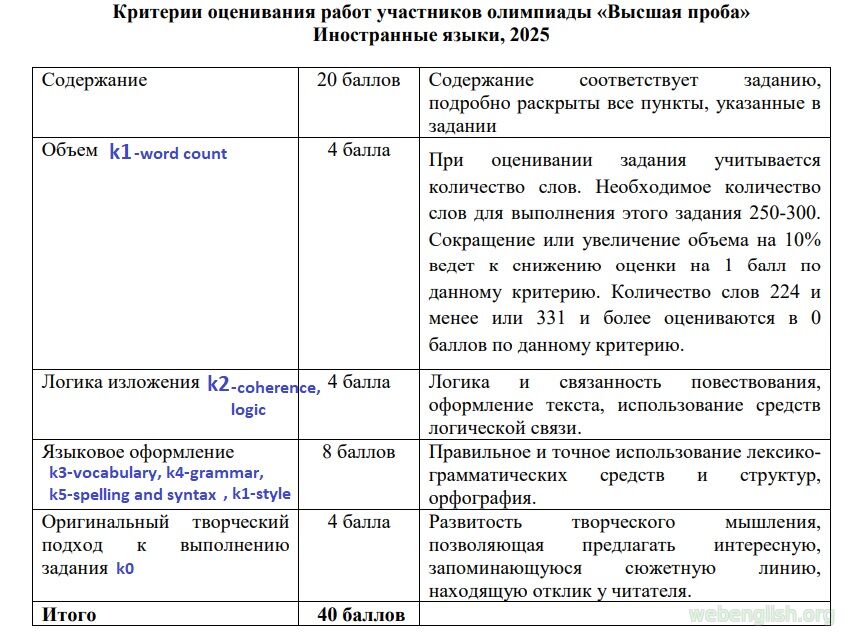
1.6. [ВОШ, Ломоносoв, Евраз, ПВГ, СПбГУ] Creative writing
You have met a man who has somehow travelled from the 1980s to the present day. He is giving an interview about his impressions of modern life and is especially shocked by today’s technology, the Internet, smartphones, social media, online shopping, and artificial intelligence.
Write the interview.
In your interview:
- introduce the guest and explain who he is;
- show his surprise, confusion, or admiration when speaking about modern technology;
- include his opinions about at least 3–4 modern inventions or habits;
- make the interview lively and realistic by using interview questions and detailed answers;
- give the interview a clear ending.
Write 220–250 words.
You may use the following expressions:
Introductory phrases for the interviewer:
- Let us begin by asking...
- To start with, could you tell us...
- What struck you most about...
- How did you react when you first saw...
- Would it be fair to say that...
- What do you make of...
- Looking back on your own time, how would you compare it with...
- Before we finish, could you say...
Useful idioms and expressive phrases:
- to feel like a fish out of water
- to be light-years ahead of something
- to blow somebody’s mind
- to take something for granted
- at the touch of a button
- to live in a different world
- to come as a shock to somebody
- to move with the times
Possible opening line:
Today we are speaking to a most unusual guest — a man who has travelled from the 1980s straight into the 21st century.